Gradescope
AI-assisted grading for handwritten exams, code, and essays — with consistency built in.
TL;DR
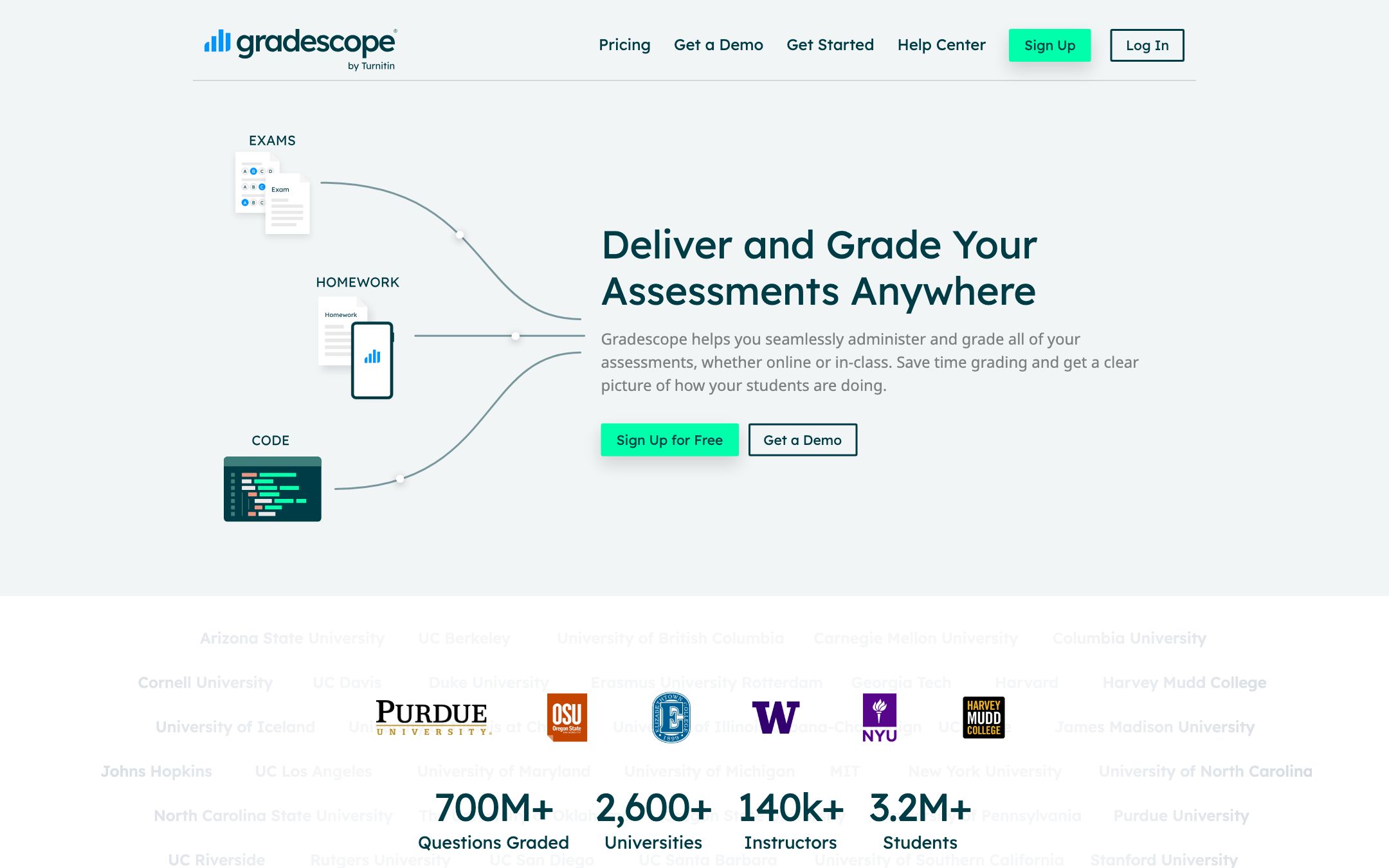
Gradescope is the gold standard for grading handwritten and free-response exams at scale. The "group similar answers" workflow is genuinely transformative — what used to be 12 hours of grading becomes 5, with better consistency.
Recommend it if
You're a high-school AP / IB teacher or a college instructor with 50+ students per exam, you give partial credit on free-response problems, or you grade student code submissions.
Skip it if
You teach K-8 with weekly worksheets (overkill), your grading is mostly multiple-choice (use Quizizz / Schoology), or your school doesn't fund per-student tools.
Quick facts
- Platforms
- Web
- Languages
- EnglishSpanishFrenchGermanMandarin
- School fit
- 9-12 Higher Ed
- Subjects
- MathSciencesEngineeringCSHumanities free-response
- Time to first output
- 30 min setup, then time-savings compound
- Learning curve
- Moderate
- Setup
- Create course, upload roster, scan exam template
- Works offline
- —
Real-world use cases
How a teacher, student or parent actually puts this tool to work.
| Who | Scenario | Time | Output |
|---|---|---|---|
| Teachers | AP Physics 100-student midterm — scan all exams, build the rubric on problem 1 across the first 30 papers, then grade the rest in 90 minutes via auto-grouping. | 4 hr (vs. 12 hr manual) | Graded exam with per-rubric analytics |
| Teachers | CS101 Python assignment — autograder runs unit tests, partial credit applied via rubric, instructor only reviews edge cases. | 30 min (vs. 6 hr manual) | Auto-graded with override |
| School leaders | Department head reviews item-difficulty analytics across 4 sections of Calc I — surfaces inconsistent rubric application between TAs. | 20 min | Cross-section consistency report |
- Teachers
AP Physics 100-student midterm — scan all exams, build the rubric on problem 1 across the first 30 papers, then grade the rest in 90 minutes via auto-grouping.
- Time
- 4 hr (vs. 12 hr manual)
- Output
- Graded exam with per-rubric analytics
- Teachers
CS101 Python assignment — autograder runs unit tests, partial credit applied via rubric, instructor only reviews edge cases.
- Time
- 30 min (vs. 6 hr manual)
- Output
- Auto-graded with override
- School leaders
Department head reviews item-difficulty analytics across 4 sections of Calc I — surfaces inconsistent rubric application between TAs.
- Time
- 20 min
- Output
- Cross-section consistency report
Gradescope is the gold standard for grading handwritten and free-response exams at scale. The auto-grouping workflow — cluster similar answers, grade once, apply to dozens — is genuinely transformative for any STEM course with 50+ students per exam.
When it pays for itself in week one
- AP / IB exams with 60+ students and partial-credit rubrics
- College STEM courses with weekly problem sets
- CS courses where you grade code with autograders + a quality rubric
- Multi-section courses where TA grading consistency matters
In K-12 it’s a niche tool — most worth-it for HS AP teachers. In higher ed it’s the default.
What we like
- + Group similar answers automatically — grade once, apply to dozens
- + Handles handwritten, typed, code and free-response in one platform
- + Industry-standard in higher-ed STEM grading
- + Strong analytics on rubric-item difficulty and grader consistency
Heads up
- − Per-student-per-course pricing — pays off in higher-ed, less so in K-5
- − Not optimised for K-8 worksheet grading (use a quiz tool instead)
- − Setup time for the rubric pays off only at scale (50+ students)
Pricing breakdown
Pricing
Verified directly on the vendor site. We re-check every quarter.
Trial
- · 1 free course per term
- · Up to 200 student responses
- · All grading features
- · Analytics
Per-Student
Most useful- · Unlimited courses and assignments
- · Code grading and autograders
- · Bulk rubric reuse
- · Roster integrations
Institutional
- · Site license with discount
- · LMS integration (Canvas, Brightspace, etc.)
- · Dedicated support and training
- · SSO and SIS rostering
Privacy & compliance
Privacy & compliance
What we found in the vendor's terms, DPA, and trust center. Verify with your district before deploying.
- FERPA
- Compliant
- SOC 2
- Compliant
- COPPA
- Partial
- GDPR
- Compliant
- Trains on your data
- No
- Data retention
- Student work retained per institution policy; instructor can export/delete on demand.
- Hosting regions
- US · EU
Owned by Turnitin since 2018. FERPA-aligned with signed DPA for institutions. Used in most R1 universities; widely vetted for HE deployment.
Works with
- Canvas
- Brightspace
- Blackboard
- Moodle
- Google Classroom (limited)
Frequently asked questions
Frequently asked questions
Is the AI in Gradescope generative or just clustering?
Mostly clustering — Gradescope groups similar handwritten / typed responses so you grade once and apply to all. Recently added generative-AI rubric suggestions for short-answer items, but the core value is clustering, not generation.
How accurate is the handwriting OCR?
Strong on English-language standard handwriting, weaker on math symbols and non-Latin scripts. The clustering works on visual similarity, not just OCR text — so even illegible answers cluster correctly when they're similar.
Does it integrate with my LMS?
Yes — Canvas, Brightspace, Blackboard and Moodle all sync rosters and push grades back. Google Classroom integration is lighter.
Can I use it for K-8?
You can but it's overkill for elementary. The setup overhead pays off at 30+ students per assignment with rich rubrics. For weekly K-8 worksheets, a quiz tool is faster.
How does it handle code grading?
Code is a separate workflow — you write an autograder (Python, etc.) that runs unit tests on every submission, then layer a rubric on top for code-quality / partial-credit items. It's the gold standard for CS courses.
Tags
You might also like
When to pick it
CoGrader
★Grading & Feedback
Cuts essay grading time by ~80% with rubric-aligned AI feedback you can edit.
You're grading essays specifically and want generative comments, not rubric-clustering.
MagicSchool AI
★Lesson Planning
All-in-one AI workspace built for K-12 teachers — 80+ tools in one tab.
You want a broader suite of teacher tools rather than a deep grading specialist.